Exploring how consistent daily patterns create stable physiological conditions and how repetition generates predictable feedback loops.
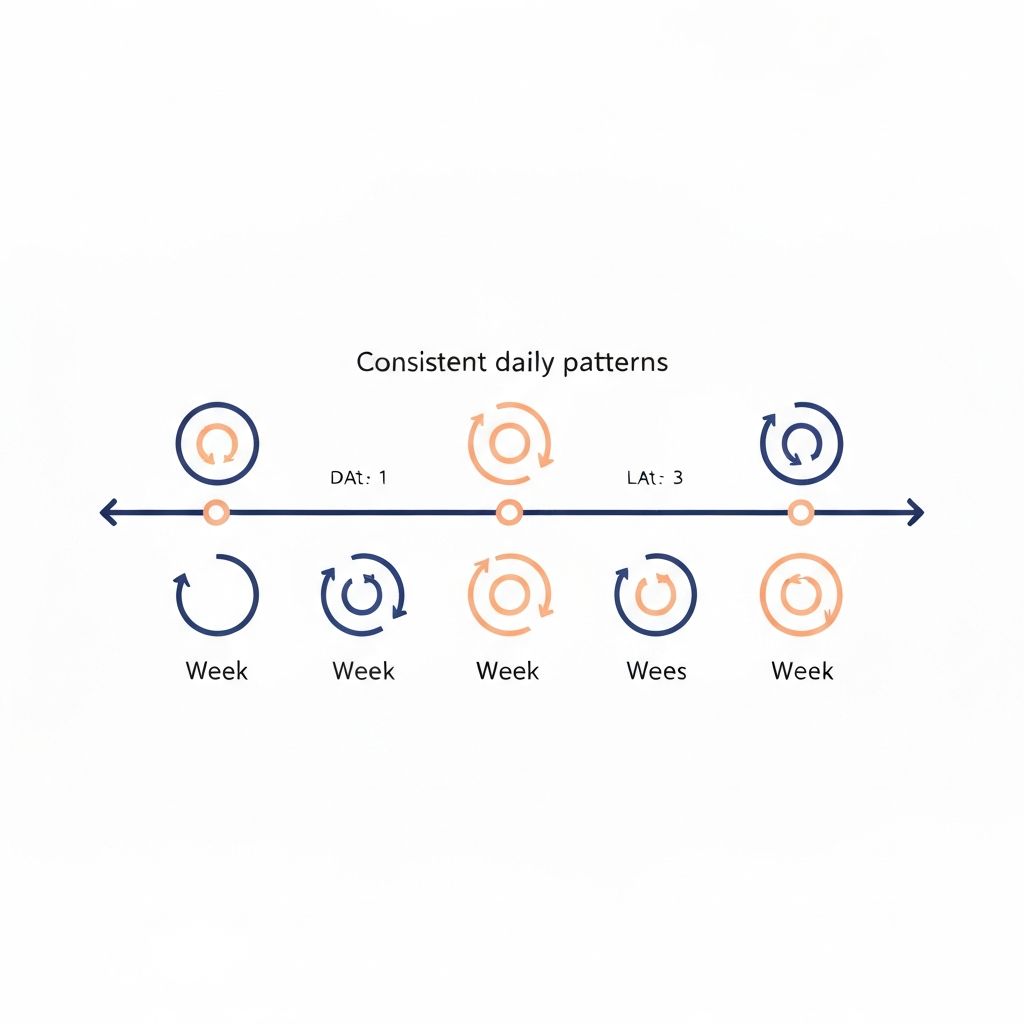
The body and brain are fundamentally adaptive systems. Repeated patterns—whether daily eating times, consistent food types, or habitual routines—create conditions to which physiological systems adapt. Consistency creates predictability, and predictability allows physiological systems to optimize their responses.
When daily patterns vary unpredictably, physiological systems must constantly adjust. When patterns are consistent, physiological systems can stabilize around those patterns, creating efficient, predictable responses.
Biological rhythms (circadian cycles) adapt to consistent daily patterns. If meals consistently occur at particular times, the body's circadian system adapts—digestive enzyme secretion, hunger hormone timing, metabolic rate—all adjust to match habitual eating times.
This adaptation supports efficient processing of habitually-timed foods and creates predictable physiological responses. Conversely, inconsistent meal timing prevents circadian adaptation, requiring constant physiological adjustment.
The body's metabolic systems show adaptation to consistent food intake patterns. When daily intake is stable, metabolic rate and energy processing adapt to that level of intake. When intake is highly variable, metabolic systems must constantly readjust.
This adaptation does not necessarily represent change in overall outcome; it represents physiological efficiency—the body optimizing its processing for the actual conditions it experiences.
The digestive system shows significant adaptation to consistent dietary patterns. Enzyme production, stomach acid timing, intestinal motility—all adapt to habitual eating patterns. Consistent patterns support consistent physiological responses; inconsistent patterns prevent adaptation and require constant adjustment.
The familiar saying that "the body adapts to routine" reflects this reality: repeated patterns allow physiological optimization.
Hunger and satiation systems adapt to consistent eating patterns. Regular meal timing creates predictable hunger patterns that align with habitual eating times. Regular food types create consistent satiation responses aligned with normal intake volumes.
These adaptations make established eating patterns feel natural and automatic—the body's physiological systems support them.
Established eating patterns create self-sustaining feedback loops. Consistent intake creates adapted physiological responses; adapted physiological responses create efficient, satisfying experiences; satisfying experiences reinforce pattern continuity. The pattern sustains itself through consistent physiological feedback.
This self-sustaining nature of established patterns explains their stability—they are maintained not just by neural habit systems but by adapted physiological responses that support the pattern.
When daily energy intake is consistent, overall energy balance remains stable. The body's energy-regulating systems, operating in a stable environment, maintain equilibrium. When intake is variable, the energy balance system must constantly adjust.
Stable patterns create stable physiological conditions; variable patterns create dynamic, constantly-adjusting conditions. Neither is inherently good or bad—they represent different physiological challenges and responses.
When established patterns are disrupted (vacation, schedule changes, environmental shifts), physiological adaptation must adjust. This creates temporary instability—hunger patterns become unpredictable, digestive responses become variable, metabolic efficiency decreases temporarily.
Over time, new patterns establish new adaptations. The physiological flexibility that allows adaptation to new patterns also explains why changing established habits can feel uncomfortable initially—physiological systems must readapt.
Individuals vary substantially in their physiological adaptation rates and degrees. Some adapt quickly and completely to new patterns; others adapt more slowly or incompletely. These variations reflect genetic, developmental, and health-related differences in physiological systems.
This individual variation means that the same consistent pattern creates different physiological adaptations in different individuals.
Pattern consistency operates at multiple scales: daily patterns (when and what we eat each day), weekly patterns (variation across days of the week), monthly patterns, seasonal patterns. Physiological systems adapt to patterns at all these scales, creating nested layers of adaptation.
Understanding eating patterns requires understanding these multiple scales of consistency and adaptation.
Educational Note: This article explores physiological adaptation to eating patterns for educational purposes. It describes general principles of how bodies respond to consistent versus variable patterns. Individual physiological responses vary substantially. This is informational content only, not dietary guidance or health advice. Consult healthcare professionals for individual health concerns.
 TheHabitCircle